

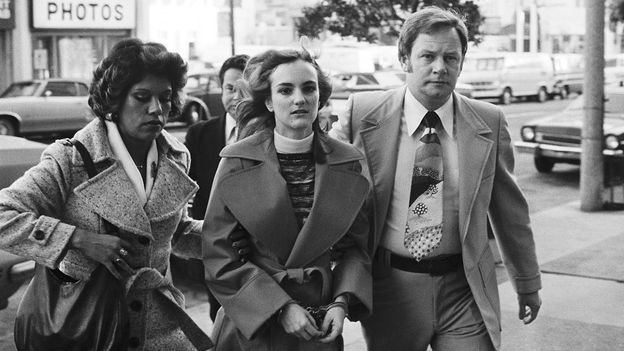
On February 4, 1974, Patty Hearst, a 19-year-old undergraduate and heiress to a powerful newspaper dynasty, was kidnapped from her off-campus apartment in Berkeley, California. Just a week later, her family received a chilling audio recording confirming she was alive, uttering, "Mom, Dad, I'm with a combat unit that's armed with automatic weapons." This event marked the beginning of a harrowing saga that would captivate the United States and generate significant media coverage, rivaling even the Watergate scandal.
Patty Hearst's abduction was executed by the Symbionese Liberation Army (SLA), a small radical group that claimed to fight against capitalism and oppression. Their first victim was Marcus Foster, an Oakland school superintendent who was murdered for attempting to introduce security measures in local schools. With Hearst, the SLA seemed to have struck at the heart of the capitalist system they despised, targeting her due to her family's immense wealth and media influence.
As the SLA's demands unfolded, they demanded that the Hearst family fund a $2 million food distribution program for the poor in California. SLA leader Donald DeFreeze, also known as "Cinque," threatened that Patty would be executed if the demands were not met. In a shocking twist, recordings were released of Hearst stating that her captors were not merely "a bunch of nuts" but were "honest with me and perfectly willing to die for what they are doing." The Hearst family complied with the SLA's demands, which resulted in a bizarre food handout program across various impoverished neighborhoods in California.
The distribution of food, however, was not without chaos. In Oakland, angry crowds clashed with organizers, leading to violence and disillusionment with the SLA's methods. Many recipients of the food aid expressed their disgust at the SLA’s tactics, emphasizing that human life held greater value than mere groceries. Hearst, who was under extreme psychological pressure during her captivity, recorded messages describing the food aid as "a real disaster," questioning the quality and intent behind the program.
'I have chosen to stay and fight'
As the weeks progressed, Patty Hearst made a pivotal decision. In a recording dated April 3, 1974, she declared, "I have chosen to stay and fight," revealing her allegiance to the SLA. This announcement came with a new identity; the group renamed her Tania, after a renowned guerrilla fighter. Her transformation into an armed participant in the SLA's activities culminated in her appearance during a bank robbery, wielding an assault rifle.
This turn of events left her family and the public in disbelief. Her father, Randolph Hearst, expressed skepticism about her rapid ideological shift, while her mother, Catherine, maintained that Patty would never have joined the SLA voluntarily. By mid-April 1974, Patty Hearst had become a fugitive, with the FBI launching a manhunt.
On May 17, 1974, a dramatic shootout occurred at the SLA's hideout in Los Angeles, resulting in the deaths of six members, some of whom were her captors. The confrontation was broadcast live on national television, making it the first of its kind. At that moment, Patty Hearst was not present at the scene, instead watching from a distance, further complicating her narrative as the media and public speculated on her loyalties.
A seven-year sentence
After over a year of evading capture, Patty Hearst was arrested on September 18, 1975, in San Francisco. During her trial for armed robbery, her defense argued that she had been brainwashed and coerced into participating in the SLA’s violent activities through a psychological phenomenon known as Stockholm Syndrome. In contrast, the prosecution presented evidence of her active involvement in the SLA, including recordings and photographs that portrayed her as a willing participant.
On March 20, 1976, after a seven-week trial, Hearst was found guilty and sentenced to seven years in federal prison. However, her sentence was commuted by President Jimmy Carter after just 22 months, and she received a full pardon from President Bill Clinton in 2001. Following her release, Hearst led a quieter life, marrying her bodyguard and pursuing writing and acting, even appearing in films directed by John Waters.
In reflecting on her experiences, Patty Hearst has stated that while she initially believed she had not been brainwashed, she later recognized the psychological control exerted over her by the SLA. Her story remains a complex examination of coercion, identity, and survival in the face of radical extremism.
Source: Bbc News